
The Green India Mission is India’s most ambitious attempt to rethink how forests are restored, managed, and valued in a changing climate. Launched as one of the core missions under the National Action Plan on Climate Change, the mission recognises forests not merely as land parcels to be planted, but as complex living systems that regulate climate, store carbon, support biodiversity, and sustain millions of livelihoods.
Unlike earlier forestry programmes that focused on plantation targets alone, the Green India Mission was designed to address a deeper problem India has faced for decades: while forest cover numbers appeared stable on paper, forest quality, ecological function, and resilience were steadily declining. Fragmentation, degradation, invasive species, and climate stress had weakened many landscapes, reducing their ability to provide long-term ecological and social benefits.
The mission was therefore conceived as a paradigm shift—from counting trees to restoring ecosystems.
Why India Needed the Green India Mission

At the same time, nearly 275 million people in India depend directly or indirectly on forests for fuel, fodder, non-timber forest produce, and livelihoods. Any decline in forest health therefore has immediate economic and social consequences.
The Green India Mission was created to respond to this dual reality: forests as climate infrastructure and forests as livelihood systems.
It is implemented by the Ministry of Environment, Forest and Climate Change and forms a central pillar of India’s climate action framework under the National Action Plan on Climate Change.
What the Green India Mission Aims to Achieve

However, the mission’s ambition goes far beyond area expansion. It explicitly focuses on enhancing ecosystem services—the benefits that forests provide to people and the planet. These include carbon sequestration, groundwater recharge, flood regulation, biodiversity conservation, and microclimate moderation.
A crucial and often overlooked goal of the mission is its emphasis on livelihood enhancement. By improving forest productivity and access to forest-based resources, the mission aims to increase income and resilience for approximately 3 million forest-dependent households.
This three-fold objective—ecological restoration, climate mitigation, and livelihood security—is what distinguishes the Green India Mission from conventional afforestation schemes.
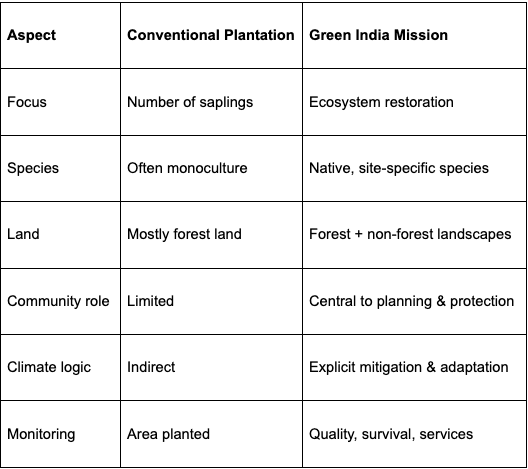
Moving Beyond “Plantation” to Ecosystem Restoration
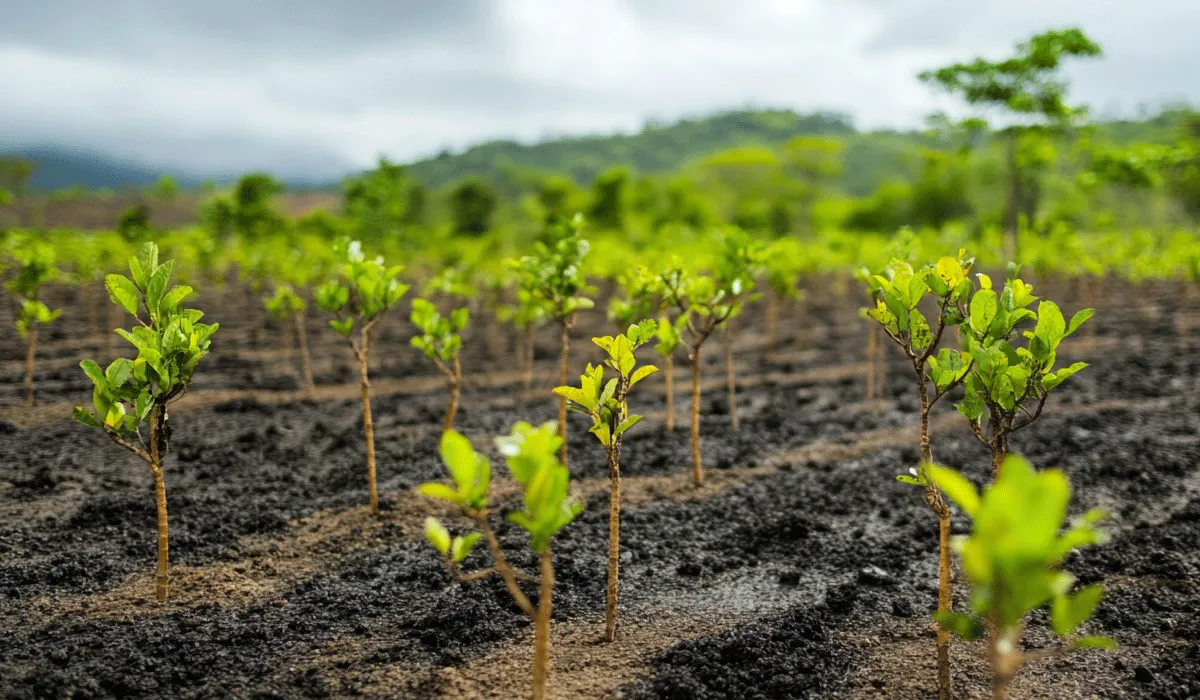
In dense and moderately dense forests, the focus is on assisted natural regeneration, enrichment planting, fire control, and invasive species management. In degraded forests, ravines, and scrublands, restoration involves soil and moisture conservation, native species reintroduction, and controlled grazing.
Mangrove ecosystems receive special attention due to their role in coastal protection and carbon storage. Wetlands and grasslands—often neglected in traditional forestry—are also included, recognising their importance in biodiversity conservation and hydrological stability.
The mission further extends to trees outside forests, including agroforestry systems, urban and peri-urban green spaces, and institutional landscapes. This ensures that climate benefits are distributed across rural and urban India, not confined to protected forest areas alone.
Carbon Sequestration and India’s Climate Commitments

The original mission document estimated that improved forest and tree cover under GIM could lead to 50–60 million tonnes of additional carbon sequestration annually. The revised mission framework for 2021–2030 aligns this ambition more closely with national climate accounting and long-term decarbonisation goals.
What makes GIM particularly relevant in climate discourse is that it represents a nature-based solution—one that delivers mitigation and adaptation benefits simultaneously, often at a lower cost than engineered alternatives.
How the Green India Mission Is Implemented

Each state prepares a State Perspective Plan, identifying priority landscapes, intervention types, and implementation strategies based on ecological and socio-economic conditions. State forest departments play a coordinating role, but community institutions such as Joint Forest Management Committees and village-level bodies are central to on-ground action.
This structure recognises that long-term forest success depends on local stewardship, not just administrative control.
Funding for the mission comes from a combination of central allocations, state contributions, and convergence with other schemes such as CAMPA and rural employment programmes. Financial data related to GIM allocations and releases is publicly available through government open-data platforms, reinforcing transparency.
Revised Green India Mission (2021–2030): What Changed
Over time, the mission framework has evolved. The revised Green India Mission for the period 2021–2030 reflects lessons learned from early implementation and aligns more closely with India’s updated climate and biodiversity priorities.
The revised approach places stronger emphasis on forest quality over sheer expansion, scientific monitoring, and convergence across programmes. While the direct central outlay under the revised framework is approximately ₹12,190 crore, the actual area treated is expected to be much larger due to multi-scheme integration.
This evolution signals a shift from isolated forestry projects to systems-level landscape restoration.
Monitoring, Reporting, and the Data Challenge
Monitoring under the Green India Mission includes tracking area treated, species planted, and financial expenditure. Government datasets published on national data portals provide state-wise and year-wise information on fund releases and implementation status.
However, experts have repeatedly pointed out that long-term success depends on moving beyond input-based metrics toward outcome-based monitoring. Survival rates, biodiversity recovery, carbon stock changes, and ecosystem service improvements must become central indicators if GIM is to fulfil its promise.
The growing interest in geospatial monitoring, remote sensing, and field-based ecological assessments presents an opportunity to strengthen GIM’s transparency and credibility.
On-Ground Impact and Real-World Outcomes
Across India, many restoration initiatives—whether led by state agencies, NGOs, or CSR partnerships—align their design with Green India Mission principles. Mangrove restoration in coastal belts, regeneration of degraded forest patches in central India, urban forest initiatives around expanding cities, and agroforestry adoption in rain-fed regions all reflect the mission’s integrated philosophy.
While implementation quality varies across states, the mission has created a common national framework for ecological restoration that did not previously exist.
Challenges the Mission Continues to Face
Despite its strong conceptual foundation, the Green India Mission faces several structural challenges. Delays in fund release, uneven institutional capacity, land tenure complexities, and climate-induced stress on young plantations all affect outcomes.
Community engagement remains critical but uneven. Where local institutions are empowered and incentivised, forest restoration has proven more resilient. Where participation is weak, long-term sustainability suffers.
These challenges underline a simple truth: forest restoration is a long-term process, not a one-time intervention.
Why the Green India Mission Matters Today
As India urbanises rapidly and climate risks intensify, forests will increasingly determine the country’s environmental resilience. The Green India Mission provides a roadmap for how restoration can be done at scale, while balancing ecological integrity and human well-being.
For policymakers, it offers a climate-aligned framework. For CSR programmes, it provides legitimacy and national alignment. For citizens, it represents an investment in cleaner air, water security, and climate stability.
Most importantly, it reframes forests not as expendable land banks, but as strategic national assets.
Conclusion
The Green India Mission is not about planting trees for numbers. It is about rebuilding ecological systems, strengthening climate resilience, and ensuring that forests continue to support both people and the planet in the decades to come.
If implemented with scientific rigour, community ownership, and transparent monitoring, the mission has the potential to shape India’s environmental future as profoundly as any industrial or infrastructure programme.
Frequently Asked Questions (FAQs) – Green India Mission
1. What is the Green India Mission in simple terms?
The Green India Mission is a government programme that aims to restore and improve forests across India to fight climate change, protect biodiversity, and support livelihoods. Instead of only planting trees, it focuses on improving forest quality, ecosystem health, and long-term sustainability. The mission is implemented under the leadership of the Ministry of Environment, Forest and Climate Change as part of India’s climate action strategy.
2. When was the Green India Mission launched?
The Green India Mission was formally approved in 2014 as one of the eight missions under India’s National Action Plan on Climate Change (NAPCC). Its implementation has since evolved, with a revised framework guiding activities from 2021 to 2030 to align with India’s updated climate commitments.
3. What are the main objectives of the Green India Mission?
The mission has three core objectives: First, to increase and improve forest and tree cover across 10 million hectares of land. Second, to enhance ecosystem services such as carbon sequestration, water regulation, soil conservation, and biodiversity. Third, to strengthen livelihoods of forest-dependent communities by improving forest productivity and sustainable resource use.
4. How is the Green India Mission different from normal plantation drives?
Unlike conventional plantation programmes that focus on the number of saplings planted, the Green India Mission focuses on ecosystem restoration. It promotes native species, assisted natural regeneration, landscape-level planning, and long-term maintenance. The success of GIM is measured not just by area planted, but by forest health, resilience, and ecosystem outcomes.
5. How does the Green India Mission help in climate change mitigation?
Forests act as natural carbon sinks. The Green India Mission contributes to India’s climate goals by enhancing carbon storage in forests and trees. Under India’s international climate commitments, forest-based missions like GIM support the national target of creating an additional carbon sink of 2.5–3.0 billion tonnes of CO₂ equivalent by 2030, while also helping communities adapt to climate impacts such as floods, droughts, and heatwaves.
6. Is the Green India Mission linked to CSR activities in India?
Yes. Activities under the Green India Mission—such as afforestation, ecological restoration, biodiversity conservation, and livelihood support—fall under Schedule VII of the Companies Act, 2013, making them eligible for Corporate Social Responsibility (CSR) funding. Many CSR-funded plantation and restoration projects align their design and reporting with GIM objectives to ensure national policy alignment and credibility.
7. How can citizens or organisations track the progress of the Green India Mission?
Progress related to the Green India Mission can be tracked through government disclosures and open data platforms that publish state-wise fund releases, implementation status, and programme details. While financial and area-based data are available publicly, experts increasingly advocate for stronger outcome-based reporting that includes survival rates, biodiversity indicators, and long-term ecosystem health.